 🃏 Collecting
 Table of Contents
Every collector hits this moment eventually: you’re forty cards from completing a set, you’ve just opened your fifth booster box, and you start doing math you should have done months ago. We did that math properly - for pack rippers, singles buyers, and the hybrid collectors in between - and the numbers are lopsided enough that they should change how you plan your next master set chase.
A quick definition so we’re arguing about the same thing: a master set means every card in the set including the secret rares and the full reverse holo run, not just the numbered base set. That distinction is where most of the cost hides.
The Structure of a Modern Set (and Why It’s Built Against You)
A typical modern Scarlet & Violet-era or Mega Evolution-era expansion runs roughly 160 - 200 numbered cards, plus anywhere from 60 to 100+ secret rares: full arts, special illustration rares (SIRs), gold hyper rares, and the reverse holo variant of nearly every common and uncommon. Prismatic Evolutions made this brutally clear with its enormous secret rare gallery, and the 2025 - 2026 Mega Evolution sets followed the same blueprint: a base set you can finish in a weekend, and a chase layer engineered to survive hundreds of packs.
That design is intentional. The reverse holo run and the SIR gallery exist to make “one of everything” cost dramatically more than “the good cards.” Your collecting strategy should respect that architecture instead of fighting it.
Method 1: Ripping Packs Only
Here’s the math nobody wants to hear. A booster pack averages one rare-or-better slot plus one reverse holo. Rough hit rates in the modern era put an SIR at somewhere around 1 in 100 - 200 packs depending on the set and the specific card. A full secret-rare gallery of 80 cards, acquired only through your own pack openings, means you are statistically committed to thousands of packs - and duplicates make the last ten cards exponentially worse than the first seventy, because you’re no longer hunting “any SIR,” you’re hunting the three specific ones you’re missing.
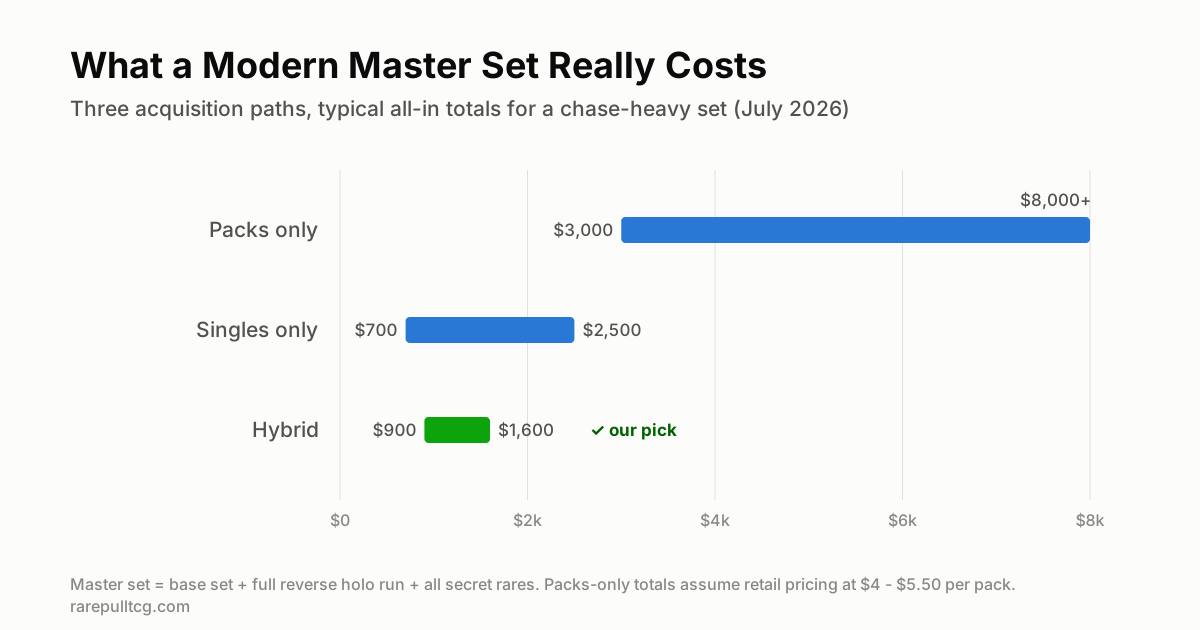
At roughly $4 - $5.50 per pack retail as of mid-2026 (when you can even find retail stock, which we covered in our guide to retail drops and where to actually buy), a packs-only master set of a chase-heavy modern expansion is realistically a $3,000 - $8,000+ endeavor, most of it converted into a mountain of bulk commons. Ripping packs is entertainment with cardboard souvenirs. It’s a genuinely bad acquisition strategy, and the sooner a collector internalizes that, the more money they keep.
Method 2: Singles Only
Now the other extreme: never open a pack, buy all ~260 - 300 cards (base plus reverses plus secrets) as singles. The counterintuitive part is how cheap most of it is. The numbered base set of a modern expansion - commons, uncommons, rares, even most regular exes - typically assembles for $40 - $80 if you buy in lots. The reverse holo run adds maybe another $60 - $120. Nearly all of a master set’s cost concentrates in the top 15 - 25 cards: the marquee SIRs and gold rares, where a single card can run anywhere from $40 to several hundred dollars depending on which Pokemon is on it (Charizard tax remains undefeated, as we’ve written about in why Charizard cards are worth thousands or nothing).
Realistic singles-only totals for a modern chase-heavy set as of July 2026: $700 - $1,500 for patient buyers who track prices for a few months, more like $1,800 - $2,500 if the set is fresh and you want it done immediately. That timing spread is the single biggest lever you control: singles prices on non-icon SIRs typically bleed 30 - 50% between a set’s release window and its first anniversary as supply saturates. Patience is a discount code.
Method 3: The Hybrid (What We Actually Recommend)
The approach that balances cost against the fact that opening packs is, you know, fun:
- Buy one booster box or a couple of ETBs at release. Cap it there. This is your entertainment budget and your bulk engine - it’ll knock out most of the commons, uncommons, and a healthy chunk of the reverse run. Figure $120 - $180.
- Inventory immediately. Build your checklist and missing-card list the same week. Uncatalogued duplicates are money you can’t see. A proper binder system matters here - our binder collection guide covers the setup we use.
- Buy the boring singles right away. Base-set holes, remaining reverses, non-chase full arts. This layer is cheap immediately and doesn’t drop much further.
- Wait on the top ten. The marquee SIRs are where release-window FOMO costs you triple. Set price alerts, watch sold listings (not asking prices), and buy the icons on the dips - typically 6 - 12 months post-release.
- Sell your duplicate hits while they’re fresh. The same early-market premium you’re avoiding as a buyer works for you as a seller. Duplicate SIRs sold in month one routinely fund a quarter of the singles budget.
Realistic hybrid total: $900 - $1,600 all-in, with a stack of pack-opening sessions included in the price, and often less after duplicate sales.
The Japanese Shortcut (and Its Fine Print)
One lever experienced master-set builders use constantly: Japanese product. Japanese booster boxes carry dramatically better pull structure - guaranteed hit slots per box, tighter set lists, and box prices that have historically run half to a third of English equivalents per meaningful hit. For collectors who just want the art, building the SIR gallery in Japanese first and upgrading to English icons later can cut the chase-layer budget by 40 - 60%.
The fine print: Japanese and English cards are different collectibles with different markets. An English master set with Japanese cards slotted in isn’t a master set - it’s two partial collections sharing a binder, and resale buyers price it that way. Japanese singles also tend to appreciate differently (larger print runs, but also a global collector base that increasingly buys direct from Japan). Our rule: pick one language per set and commit, but rip Japanese product when what you’re actually buying is the opening experience - the per-pack fun costs less and the duplicate hits still sell.
The Uncomfortable Conclusion
Run the numbers side by side and the packs-only approach costs three to five times the singles approach for an identical binder. That’s not a knock on ripping packs - it’s a reframe. Packs are the hobby’s entertainment product; singles are its acquisition market. Confusing the two is the most expensive mistake in modern collecting, and set architecture in the Mega Evolution era is explicitly designed to encourage that confusion.
One forward-looking note: with reprint waves now arriving faster than they did in the 2020 - 2022 era, the historical “sealed always goes up” assumption is shakier than it used to be, and singles-market patience keeps getting rewarded. We’ll revisit these numbers when the fall 2026 sets land - if the secret-rare galleries keep growing, the master set math only tilts further toward the patient.
Sponsored
Build Your Collection
Explore more guides, set reviews, and market insights from TCG Collector Hub.
Browse More GuidesBuild Your Collection
Discover more guides, investment tips, set reviews, and market analysis from TCG Collector Hub.