 📈 Market Analysis
 Table of Contents
Walk into any collector forum and you’ll eventually hit the same debate: are English Pokemon cards worth more, or Japanese? Ask ten people and you’ll get ten confident answers, half of them wrong.
Here’s the honest version. For the vast majority of cards, the English copy sells for more than the exact same card printed in Japanese. But the reason most people give for that is incorrect, and there’s a small group of Japanese cards that make even a 1st Edition Charizard look like pocket change.
Let’s break down what’s actually going on, with real sale prices.
The rule: English usually wins
If you put an English card next to its Japanese equivalent, same Pokemon, same artwork, same rough era, the English one almost always carries a higher price tag on the secondary market.
The myth is that this happens because English cards are rarer or printed in smaller numbers. That gets repeated constantly, and it’s backwards. The truth is much simpler, and it comes down to one word: demand.
It’s about the buyers, not the supply
The Western collector base, mostly the United States and Europe, is enormous compared to the domestic Japanese market for vintage and chase cards. More buyers chasing the same card means higher prices, full stop. Pile nostalgia on top of that (an entire generation of Western adults grew up with the English WOTC-era cards and now have disposable income) and you get sustained, demand-driven pricing that Japanese print runs simply don’t see.
This is the single most agreed-upon fact in the hobby. It is not about pull rates, it is not about how many copies were printed, and it is not about which version is “officially rarer.” It is about how many people want to buy it.
For more on how demand and condition stack up to create value, see our breakdown of why some Charizards are worth thousands and others aren’t.
A quiet second factor: grading
There’s a smaller, sneakier reason English cards command a premium at the very top end: getting a perfect grade is harder in English.
Vintage English cards are notorious for centering problems and print issues, which means a smaller share of submissions come back as a perfect PSA 10. Japanese cards, by contrast, were generally printed with tighter quality control and better centering, so a larger share earn that top grade. Fewer perfect English copies in existence means each PSA 10 English card is scarcer, and scarcity at the top drives price.
So the high end gets a double boost: more buyers AND fewer flawless copies to fight over.
Head to head: the Base Set Charizard
The cleanest way to see the rule in action is the most famous card in the hobby, the Base Set Charizard.
| Card | Grade | Sale Price | When |
|---|---|---|---|
| English 1st Edition Shadowless Holo Charizard | PSA 10 | $420,000 | 2022 (PWCC) |
| Japanese “No Rarity” Base Set Charizard (artist signed) | PSA 10 | $324,000 | April 2022 (Fanatics Collect) |
Even at the absolute top of the market, the English card won. And note the Japanese card had every advantage you could ask for: it was one of only seven PSA 10 copies known, and it was hand-signed on the case by the original artist, Mitsuhiro Arita. It still sold for nearly $100,000 less than the English version.
One terminology note that trips people up: Japanese Base Set never had an English-style “1st Edition” stamp. The earliest Japanese print is called the “No Rarity” variant, which listings loosely treat as the Japanese equivalent of 1st Edition. Different markings, same idea: the very first print run.
If you want to understand what those grade designations actually mean and why a single point can swing a card’s value by six figures, read our guide to grading Pokemon cards.
The exceptions: when Japanese cards bury everything
Now for the part that breaks the rule wide open.
The “English is worth more” logic only holds when you’re comparing cards that were both mass-produced and sold in packs. The most valuable Pokemon cards on earth were never sold in packs at all. They were Japanese tournament prizes and contest awards, handed out in tiny numbers, and almost none of them ever existed in English.
When a card was only ever made in Japanese, and only a handful of copies exist, the entire English-versus-Japanese conversation goes out the window.
The Pikachu Illustrator: the most expensive card ever
This is the king. The Pikachu Illustrator was awarded to winners of CoroCoro Comic illustration contests in 1997 and 1998, with artwork by Atsuko Nishida. Roughly 39 copies were ever officially distributed. It was never released in English. You could not buy it. You had to win it.
In February 2026, a PSA GEM MT 10 Pikachu Illustrator sold at Goldin Auctions for $16,492,000, making it the most expensive trading card ever sold at auction. (The card had previously been owned by Logan Paul, who picked it up for around $5.275 million in 2021.)
To appreciate how insane that climb is: back in September 2013, a PSA 9 copy was listed on eBay for $100,000 or best offer, drew more than 430 offers, and sold for around $50,000. Roughly a decade later the top copy crossed sixteen million.
The Trophy Pikachu “Trainer” cards
Right behind the Illustrator sit the 1998 Trophy Pikachu cards, awarded to the top finishers at official Japanese tournaments. These are spectacularly scarce by design.
| Card | Grade | Sale Price | When |
|---|---|---|---|
| No.1 Trainer Trophy Pikachu | PSA 9 | $3,000,000 | Sept 2025 |
| No.3 Trainer Trophy Pikachu | PSA 10 | $1,769,000 | May 2026 |
| No.2 Trainer Trophy Pikachu | PSA 10 | $444,000 | July 2023 |
According to PSA, the most valuable trophy cards are the “Trainer” cards, printed in quantities of fewer than 100, and the surviving population available to buy is even smaller than the number awarded. The very first official Japanese tournament in 1997 handed out only about four copies each of its first, second, and third place cards. Cards from the 1997 to 1999 window are especially coveted.
Other Japanese-only prize cards worth a fortune
The Illustrator and the Trophy Pikachus get the headlines, but the pattern repeats across the whole category of Japanese-exclusive prizes:
- University Magikarp (Tamamushi University Promo): a PSA 10 sold for $66,100 back in February 2021. More recent sales have gone much higher, with a PSA 10 hitting roughly $186,000 in early 2026 and a BGS Pristine 10 reportedly reaching $210,800.
- 1999 Tropical Mega Battle No.2 Trainer: a PSA 10 sold for $81,250 in March 2025.
None of these ever had an English counterpart. Their value comes entirely from being Japanese, scarce, and historically significant.
So what should a collector actually take away?
Two rules that look contradictory but aren’t:
-
For normal cards, English is usually the more valuable version. If you’re holding the same card in both languages and want maximum resale value, the English copy almost always wins, because the Western collector base is bigger and hungrier. The exception is graded condition, where a Japanese card may be easier to land in a perfect PSA 10.
-
For the rarest cards on earth, Japanese is in a league of its own. Every single record-setting Pokemon card, the ones that sell for hundreds of thousands or millions, is a Japanese prize or contest card that was never printed in English.
The reconciling idea is supply. Mass-produced cards are priced by demand, and English demand is larger. Prize cards are priced by scarcity, and the scarcest cards happen to be Japanese.
For most of us, this is academic, since nobody’s flipping a sixteen-million-dollar Pikachu. But it matters when you’re deciding which language to buy for a card you actually want to hold long term. If it’s a standard set card, lean English for resale. If you’re chasing genuine grails, you’re shopping in Japanese whether you like it or not.
Want to put this into a broader buying strategy? Our Pokemon TCG investing guide covers how to think about appreciation, timing, and the mistakes that cost new collectors the most money.
Prices reflect documented public auction and sale records and are point-in-time data. The collectibles market moves fast, and several of the figures above have already been beaten by newer sales. Always check current comps before buying or selling.
Sponsored
Build Your Collection
Explore more guides, set reviews, and market insights from TCG Collector Hub.
Browse More Guides
Build Your Collection
Discover more guides, investment tips, set reviews, and market analysis from TCG Collector Hub.
You Might Also Like
 Market Analysis
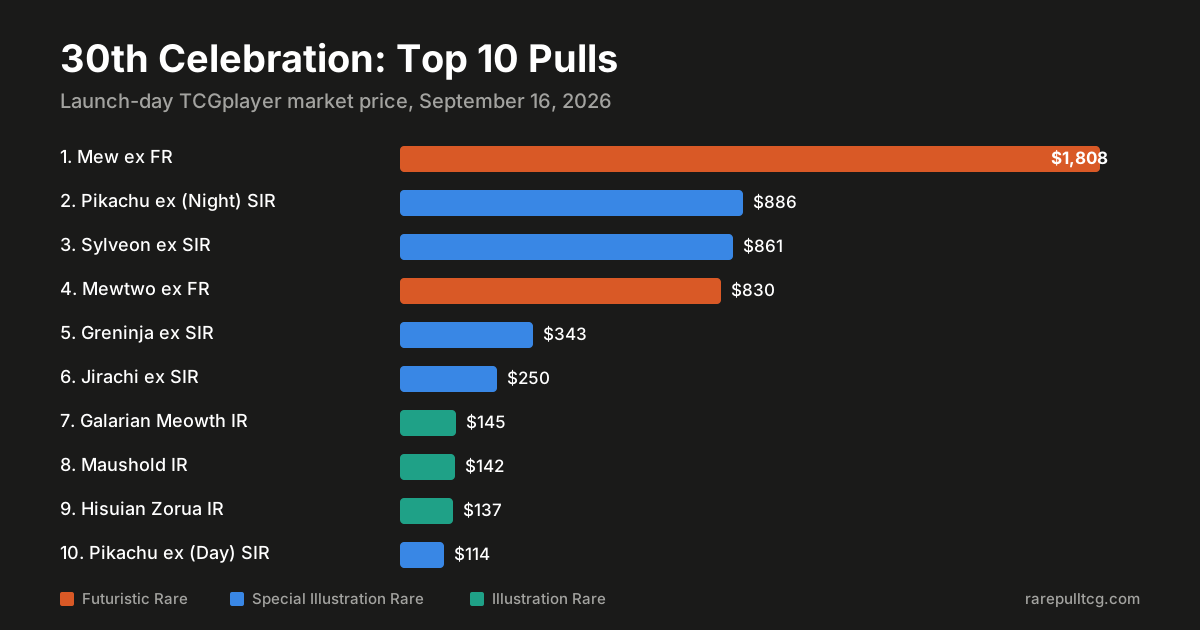
 Pokemon 30th Celebration Is Out Today: The Top 10 Pulls, Launch-Day Prices, and What We Would Actually Chase
 Market Analysis
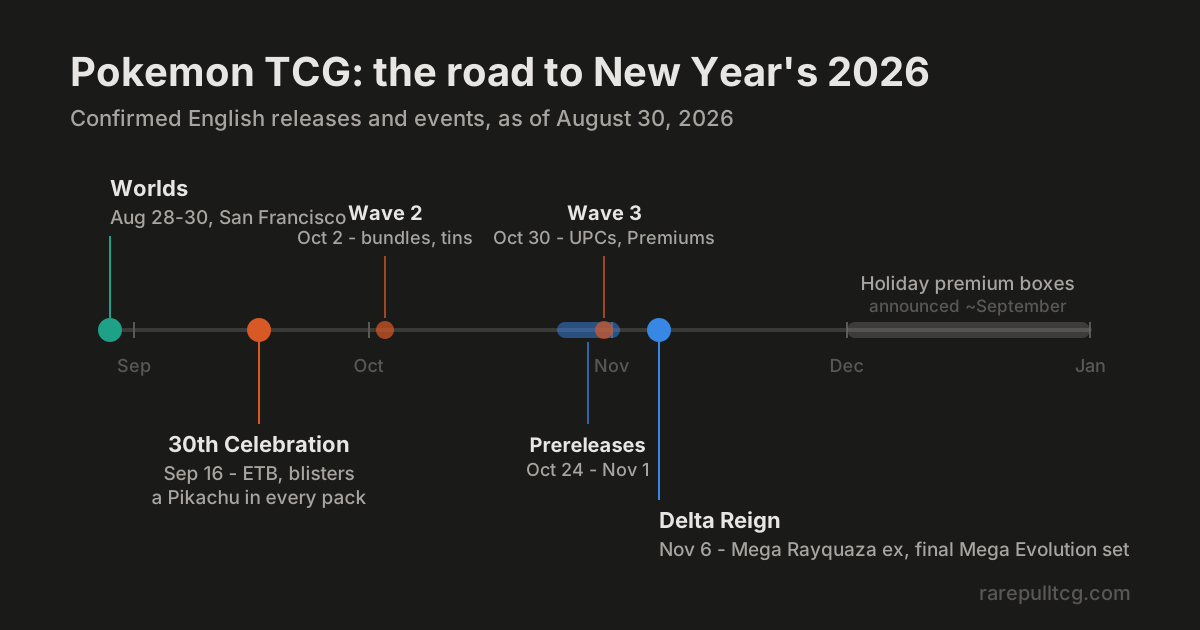
 Pokemon TCG Q4 2026 Preview: Worlds, 30th Celebration, Delta Reign, and Where the Money Goes
 Market Analysis