 🃏 Collecting
 Table of Contents
How to Spot a Pokemon Card Reprint Without a Loupe
Reprints aren’t always counterfeits. Pokemon has legitimately reprinted hundreds of cards over the years - Celebrations brought back classics, Trainer’s Toolkit reissued Switches and Potions, and the 151 set re-released the entire original lineup. But most collectors paying premium prices for a Charizard, Lugia, or Mew want to know whether they’re holding the original print run or a later reissue.
Here’s how to tell - fast, in your hand, without flipping a card under a 10x loupe.
1. Check the Set Symbol First
This is the single fastest tell. Every Pokemon card has a small set symbol on the bottom-right of the artwork (or bottom-right of the card on older sets). The symbol tells you exactly which set the card came from - and therefore whether it’s an original or a reprint.
A few of the most-reprinted cards and their original symbols:
- Base Set Charizard - no set symbol on Shadowless and 1st Edition; later prints have a small “Charizard” symbol
- Neo Genesis Lugia - uppercase “N” with a star
- Celebrations 25th Anniversary cards - silver “25” logo
- 151 reprints - set symbol unique to that release
Look up the original set’s symbol before you buy. If the card has a different symbol, it’s a different print run - usually worth significantly less even if the art is identical.
2. Look at the Yellow Border
Hold the card flat under good light and look at the yellow border. On a genuine modern Pokemon card, the yellow is consistent - no streaking, no shift to green, and the corners are sharp.
Common reprint and counterfeit tells:
- Yellow that looks slightly pale or faded compared to a known-genuine card from your collection
- A faintly visible dark line running along the inside of the yellow border (a printing artifact you don’t see on official prints)
- Border color that bleeds slightly into the artwork frame
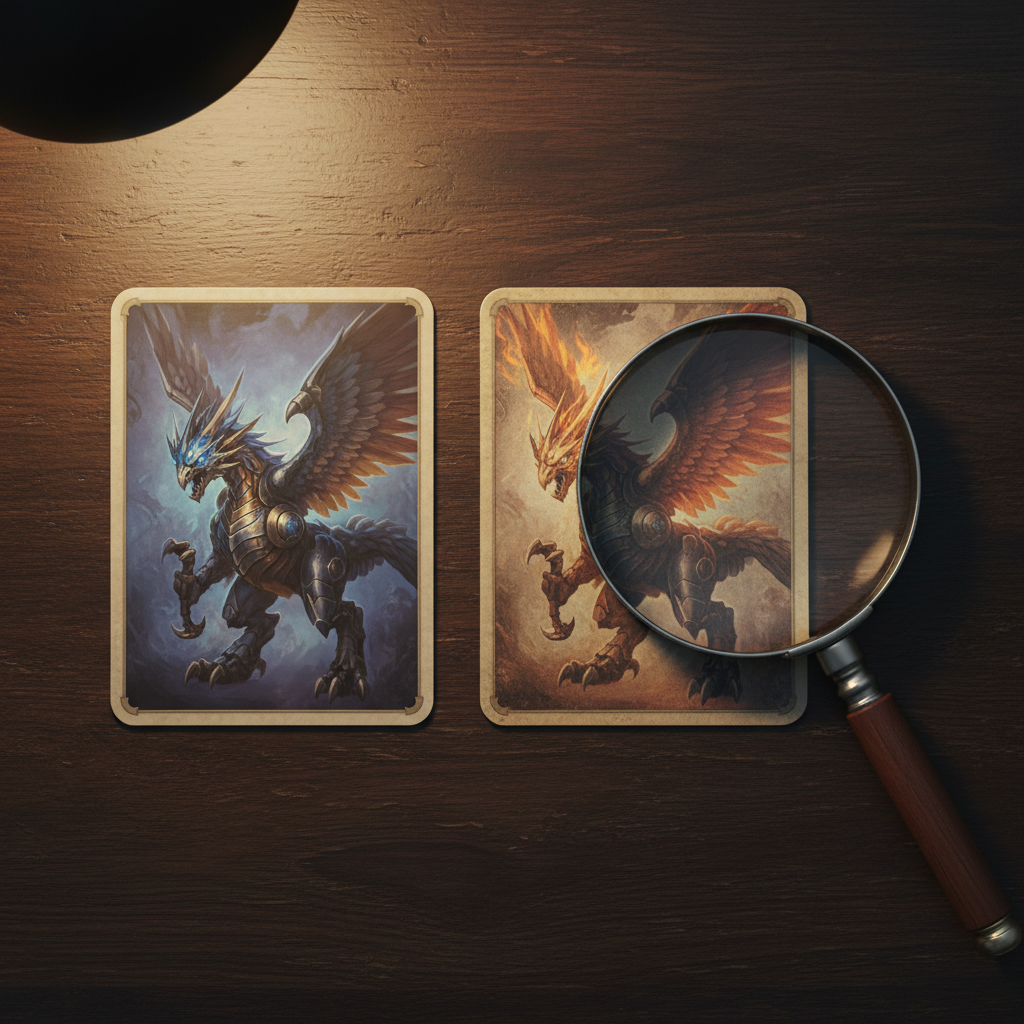
The fastest way to spot a problem is to put the card next to a known-genuine card from the same era. Mismatches jump out.
3. The Light Test
Hold the card up to a bright light source - phone flashlight, lamp, sunlit window. Look at it edge-on.
A genuine Pokemon card is built from three layers: the front print, an opaque blue-black core layer, and the back print. Held to light, almost no light passes through.
A counterfeit (and many cheap reprints) skip the core layer or use a thinner one. Light passes through clearly enough to see the back print bleed through to the front, or vice versa. If you can read the back of the card by holding the front to a bright light, it’s almost certainly fake.
This test alone catches 80% of the obvious counterfeits sold on auction sites and at low-end card shows.
4. Check the Texture (Holos and Modern Cards)
For holographic cards, the texture is one of the hardest things for counterfeiters to replicate. Run a fingernail gently across the holographic area:
- Genuine modern holos have a faintly raised, slightly grippy texture
- Counterfeits are usually completely smooth, like a glossy postcard
Some legitimate reprints (especially from Asian markets) feel slightly different from English originals - but they should still have some texture if they’re holo.
5. Look at the Energy Symbols and Font
This is one of the most reliable counterfeit tells. Look closely at the energy cost symbols on attacks:
- The colored energy circles should have crisp, defined edges
- The font for attack damage numbers should be even and bold
- The card name font has specific letter spacing - counterfeit cards often look slightly squished or stretched
If anything looks “off” about the lettering - too thin, too thick, slightly the wrong shape - trust your eye. The real cards are remarkably consistent. Anything that doesn’t look right usually isn’t.
6. The Back Pattern
Flip the card over. The classic Pokemon card back has a specific blue swirl pattern with the Pokemon logo in a yellow circle.
Look for:
- The swirl pattern should be sharp, not smudgy or pixelated
- The Pokemon logo lettering should be clean and bold
- The dark blue background should be uniform, not blotchy
- The card border should be a consistent thin line
Stack the suspect card on top of a known-genuine card of the same era and compare backs. If they’re not nearly identical, you have a problem.
When You Still Can’t Tell
If you’ve gone through these checks and you’re still uncertain - especially on a high-value card - your two best options are:
- Submit it to a grading service. PSA, BGS, and CGC will flag counterfeits during the authentication step. You don’t have to grade the card; some services offer authentication-only.
- Compare to a verified photo. Pokemon’s official site, Bulbapedia, and the major grading registries have high-resolution photos of every official print run. Side-by-side at full zoom catches almost everything.
A Quick Field Test for Modern Reprints (Celebrations, 151, Classic Collection)
The post-2020 reprint era has its own set of tells that the original 1999 detection methods miss. Here is the abbreviated checklist for the three reprint lines most likely to land in your stack as of May 2026:
- Celebrations (2021) classic reprints. Look for the silver “25” anniversary stamp on the bottom-right of the artwork. Every Celebrations reprint of Base Set Charizard, Venusaur, Blastoise, etc. has it. No stamp means it is not a Celebrations card, which means you are looking at either an original or something less legitimate.
- 151 (sv3pt5) reprints. The 151 set logo is unique to that release. Charizard from 151 is card #6 in the set, with a Modern Battle Styles holo pattern that looks completely different from any Base Set holo treatment. If a 1999-style Base Set Charizard has a 151 set symbol, it is a 151 print.
- Classic Collection inserts (Celebrations special slots). These are the closest visual match to the original prints, because they are deliberately faithful reproductions. The tell is the holo foil - Classic Collection uses a modern texture that catches light differently than original Wizards-of-the-Coast-era holos. Hold both at the same angle and the difference is obvious.
If you are routinely buying reprint-era cards, take ten minutes to memorize the set symbols for Celebrations, 151, Trainer’s Toolkit, and any other reprint product. Most “is this real?” questions on collector forums are actually “is this an original or a reprint?” questions, and the symbol answers in two seconds.
The Bottom Line
You don’t need a loupe to spot most reprints and counterfeits. Set symbol, yellow border, light test, texture, font, and back pattern - six checks, two minutes per card, no equipment. For anything under $50, those checks are usually enough. For anything over a few hundred dollars, send it to a grader.
For the deeper authentication playbook covering outright fakes (not just reprints), see our full guide to spotting fake Pokemon cards. If you are about to grade a card, the PSA vs BGS vs CGC comparison covers which service flags counterfeits during authentication.
The market is full of reprints honestly being sold as reprints, and counterfeits trying to pass as originals. Knowing the difference is the single most valuable skill a collector can develop.
Sponsored
Build Your Collection
Explore more guides, set reviews, and market insights from TCG Collector Hub.
Browse More Guides
Build Your Collection
Discover more guides, investment tips, set reviews, and market analysis from TCG Collector Hub.