 🃏 Collecting
 Table of Contents
Your Pokemon card collection represents real money. Whether you’re sitting on a vintage Base Set Charizard or a stack of fresh Scarlet & Violet pulls, how you store those cards directly determines what they’re worth years from now. A PSA 10 can be worth ten times a PSA 8, and the difference often comes down to storage choices made long before grading ever happened.
This guide covers everything you need to know to protect your collection, from the basics of sleeves and toploaders to climate control and common mistakes that quietly destroy cards over time.
Why Storage Matters More Than You Think
Condition grading is ruthless. Graders at PSA, BGS, and CGC are looking at four things: centering, corners, edges, and surface. Every one of those can be damaged by poor storage, corners get dinged in loose boxes, surfaces get scratched from unsleeved cards rubbing together, edges wear down from repeated handling.
The financial stakes are real. A 1st Edition Base Set Charizard in PSA 10 has sold for over $400,000. That same card in PSA 7 is worth a fraction of that. For modern cards, the gap is just as sharp, a popular alternate art in Gem Mint can be worth 5-10x the same card in Near Mint.
Beyond investment value, proper storage preserves your collection as a collection. Cards hold memories, represent sets you’ve chased, and document the history of a hobby you care about. They deserve to be kept in the condition you found them.
The Foundation: Penny Sleeves and Toploaders
Every card worth protecting starts with the same two-step system.
Penny sleeves are thin, soft plastic sleeves that slide over the card first. Despite the name, they’re not just for cheap cards, they’re the first layer of protection against surface scratches and debris. Get them in the correct size for the card you’re sleeving. Standard Pokemon cards fit standard sleeves. Jumbo cards, ETB promos, and oversized cards need their own sizing.
Toploaders are the rigid plastic holders that go over the penny-sleeved card. They lock the card in place and protect corners and edges from bending. For valuable singles, a toploader stored vertically in a box is the simplest reliable solution. A card in a penny sleeve inside a toploader, sealed with a small piece of painter’s tape across the top opening, is well-protected against most everyday hazards.
For cards going to grading, this combo is also standard practice, graders receive thousands of cards in penny sleeve + toploader sets every day.
Card savers (semi-rigid holders) are a popular alternative to toploaders for submission to graders since they’re easier to stack and ship, but toploaders are the collector’s everyday standard.
Binder Storage: Pros, Cons, and What to Look For
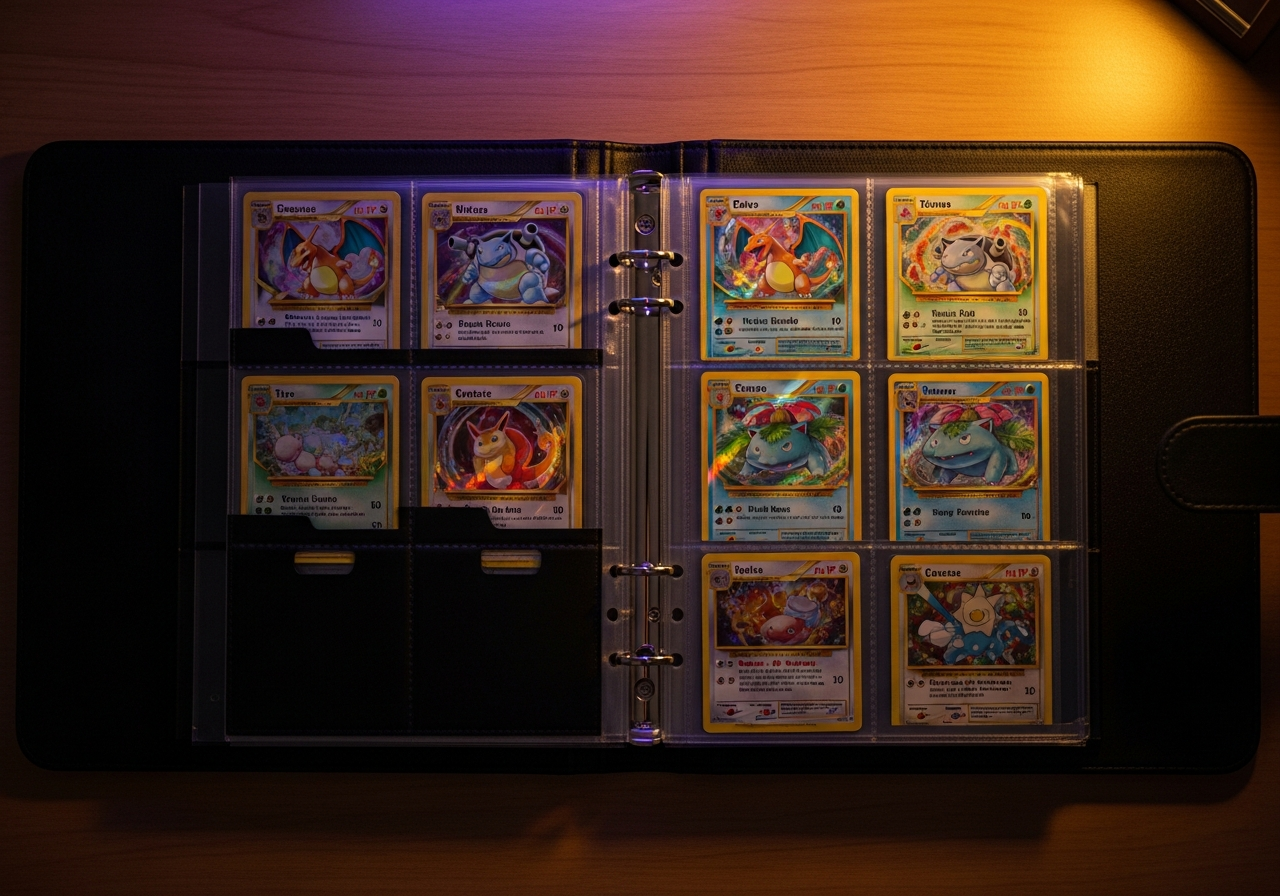
Binders are great for sets you want to display, browse, and show off. They’re satisfying to flip through and make organizing by set, type, or rarity intuitive. But not all binders are equal, and some will quietly damage your cards.
The ring binder problem: Traditional D-ring or O-ring binders are one of the worst things you can use for valuable cards. When the binder is closed, pages on the spine side of the ring get bent slightly inward at the top and bottom. Over time, that stress creates edge wear and corner damage. If you’re using a ring binder for anything valuable, stop.
Side-loading pages are the answer. Side-loading binder pages hold cards in from the side rather than the top, which means gravity doesn’t pull cards down and out of the pockets, and there’s less movement and friction. Pair side-loading pages with a binder that uses a zipper or no rings at all, portfolio-style binders without rings are the gold standard.
Ultra PRO, Dragon Shield, and Vault X are the most respected brands for binder pages and binders themselves. Avoid no-name pages with PVC material, PVC off-gasses over time and can damage card surfaces.
For master sets and display collections, a good binder system is hard to beat. For raw valuable singles waiting for grading or sale, toploaders and boxes are safer.
Bulk Storage: Boxes Done Right
For bulk commons, uncommons, and cards you’re holding in volume, cardboard storage boxes (often called BCW boxes or monster boxes) are the standard. They’re cheap, stack well, and when used correctly, do the job.
A few rules for bulk box storage:
- Sleeve everything. Even bulk cards deserve a penny sleeve. It prevents edge wear and surface damage when cards rub together.
- Keep boxes full or use dividers. Cards that flop around in a half-empty box get corner damage. Fill the box or use cardboard dividers to keep everything upright and snug.
- Label clearly. Organize by set, date, or type and label the outside of each box. You’ll thank yourself when you need to find something six months later.
- Store horizontally or vertically, but be consistent. Some collectors prefer vertical (like a filing cabinet), some horizontal (stacked flat). Both work. Mixing them creates pressure points.
For long-term storage of larger quantities, plastic trading card boxes with lids offer better protection against moisture and pests than open cardboard.
Climate and Humidity Control
This is the storage factor most collectors underestimate until they open a box and find warped cards.
Humidity is the enemy. Pokemon cards are made of paper core laminated with plastic layers. High humidity causes the paper core to absorb moisture and expand unevenly, leading to warping, curling, and in severe cases, delamination. The sweet spot for long-term card storage is 35-55% relative humidity.
Temperature matters too. Extreme heat can warp cards and degrade the plastic layers. Freezing temperatures followed by warming can cause condensation inside sealed containers. Aim for a stable room temperature, 65-72°F (18-22°C) is ideal.
Practical steps:
- Store in a climate-controlled room, not a garage, attic, or basement where temperature and humidity swing wildly
- Use silica gel desiccant packets inside storage boxes to absorb excess moisture
- If you live in a humid climate, consider a small dehumidifier in your storage area
- Avoid storing cards near windows, radiators, or vents
For extremely valuable cards, some collectors use airtight acrylic cases with controlled environments. That’s probably overkill for most collections, but if you’re holding cards worth thousands raw, it’s worth considering.
Common Storage Mistakes to Avoid
Rubber bands. This still happens. Rubber bands indent edges, crack corners, and leave residue on card surfaces. Never use them, even on bulk commons.
Shoeboxes. The original Pokemon storage solution for most of us, and a legitimately bad one for anything valuable. Cardboard shoeboxes offer no humidity control, poor structural support, and no protection against pests or light. Nostalgia aside, upgrade to proper storage boxes.
Direct sunlight. UV light fades card colors, yellows whites, and degrades the finish on holofoil cards over time. Never display or store cards in direct sunlight. If you’re displaying cards, use UV-protective cases or frames.
Stacking unsleeved cards face-to-face. The holo surface is especially vulnerable to surface scratching from contact with other cards. Even brief contact between unsleeved cards causes micro-abrasions that graders will catch.
Storing in cars. Temperature swings in a parked car are some of the most extreme a card will ever experience. Even a short trip to a card shop shouldn’t mean leaving valuable cards in a hot car.
Digital Inventory Tracking
A collection you can’t track is a collection you can’t manage. Digital inventory tracking serves two purposes: knowing what you have, and documenting what it’s worth.
Apps like TCGPlayer’s collection tracker, Dex, and Collector let you scan cards, log conditions, and track current market values. For a serious collection, a simple spreadsheet with card name, set, condition, purchase price, and estimated current value is a minimum baseline.
Good inventory documentation also matters for insurance purposes. If your collection is worth significant money, homeowner’s or renter’s insurance typically requires documentation for a collectibles claim. Photos of high-value cards and purchase receipts are worth keeping.
Frequently Asked Questions
Do I need to sleeve bulk commons and uncommons? For anything you plan to keep long-term or might ever trade or sell, yes, penny sleeves are cheap enough that there’s no good reason not to. For true bulk you’re planning to give away or donate, it’s less critical.
What’s the best sleeve brand for valuable cards? Dragon Shield and KMC Hyper Matte are widely considered the best for premium protection. Ultra PRO Platinum sleeves are also excellent. Avoid cheap no-name sleeves with PVC content.
Can warped cards be fixed? Sometimes, carefully. The most common method is to place the card flat under heavy books in a climate-controlled environment for 24-48 hours. For mildly warped cards, this can work. Severely warped cards may not fully recover, and any attempt to fix warping can itself cause further damage if done carelessly.
Should I remove cards from booster packs immediately or leave them sealed? Cards left in sealed packs are actually more protected against physical damage than loose cards. If you’re pulling to play or collect, sleeve immediately after opening. If you’re pulling to grade specific cards, handle as minimally as possible and sleeve the moment a pull hits the table.
Proper storage isn’t glamorous, but it’s the foundation everything else in collecting sits on. A well-stored collection holds its value, stays organized, and stays mint. That’s the difference between a collection and an investment, and between a good memory and a great one.
Sponsored
Build Your Collection
Explore more guides, set reviews, and market insights from TCG Collector Hub.
Browse More Guides
Build Your Collection
Discover more guides, investment tips, set reviews, and market analysis from TCG Collector Hub.