 🃏 Market Trends
 Table of Contents
On March 5, 2026, Nintendo and Game Freak dropped Pokemon Pokopia as a Switch 2 exclusive, and the Pokemon world hasn’t been the same since. Pokopia earned the highest Metacritic score of any Pokemon game ever made. Critics called it a masterpiece. Players called it life-changing. And card collectors? They called their local game shops and started panic-buying every Ditto card they could find.
The premise is what makes it special. You don’t play as a trainer or a kid from Pallet Town. You play as a Ditto. Your Ditto transforms to imitate a human and sets out to rehabilitate a post-apocalyptic world, building relationships, restoring communities, and using its transformation ability to become any Pokemon the situation demands. It’s weird, heartfelt, and totally unlike anything Pokemon has done before.
Within days of launch, the market responded. A Ditto (Squirtle) reverse holo from the EX Delta Species set that had been sitting at $89 rocketed to $245. That’s a 174% jump in less than a month. And it wasn’t alone. Across every era of the TCG, Ditto cards started climbing. Vintage cards doubled. Modern cards that nobody cared about suddenly had waitlists.
Welcome to the Pokopia Effect.
Why Ditto Cards Specifically?
You might be wondering why Ditto of all Pokemon is driving this kind of market movement. Ditto has spent most of its existence as a punchline. The purple blob that sits in the day care and breeds with everything. It was never the star of anything. Until now.
Pokopia’s entire core mechanic revolves around Ditto transforming into other Pokemon. You spend the whole game shapeshifting, adapting, and solving problems through transformation. That gameplay loop maps directly onto a very specific subset of Pokemon cards: the ones that show Ditto disguised as other Pokemon.
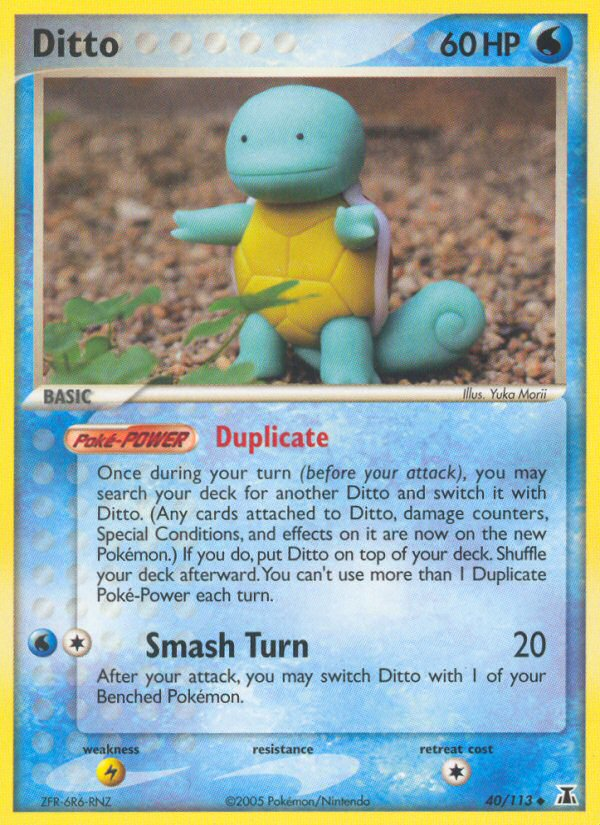
The EX Delta Species set, released in 2005-2006, featured exactly this concept. Cards like Ditto (Squirtle), Ditto (Charmander), and Ditto (Bulbasaur) depicted Ditto mid-transformation, wearing the skin of another Pokemon with its signature beady eyes and goofy smile showing through. These cards were always fun novelties. Now they feel like prophetic art that predicted a game released twenty years later.
Here’s the thing that makes this especially potent for prices: those EX Delta Species cards will never be reprinted. They’re from a specific era of the TCG with a fixed print run that ended two decades ago. Every card that gets damaged, lost, or locked away in a graded slab reduces the available supply permanently. When you combine permanent scarcity with a sudden explosion in demand from the biggest Pokemon game ever made, prices do exactly one thing. They go up.
Ditto went from joke Pokemon to beloved protagonist overnight, and the card market is reflecting that transformation in real time.
The Biggest Price Movers Since Pokopia Launched
Let’s look at the numbers. These are the Ditto cards that have seen the most dramatic price movement since Pokopia hit shelves on March 5th.
| Card | Set | Before Pokopia | After Pokopia | Change |
|---|---|---|---|---|
| Ditto (Squirtle) #40 Reverse Holo | EX Delta Species | $89 | $245 | +174% |
| Ditto (Charmander) #37 | EX Delta Species | — | $171 | Rising fast |
| Ditto (Bulbasaur) #36 | EX Delta Species | — | $130 | Rising fast |
| Japanese Ditto | Vending Series 2 | $63 | $108 | +71% |
| Ditto | Triumphant (2010) | $4.26 | $8.84 | +107% |
| Ditto Reverse Holo | Boundaries Crossed | — | — | +40% |
The Squirtle variant leads the pack because Squirtle is one of the original starter trio and has its own massive fanbase. Charmander and Bulbasaur are both climbing fast too, with no signs of slowing down. If you want the full Delta Species starter trio of Ditto transformation cards (Squirtle, Charmander, and Bulbasaur), you’re looking at a minimum of $546 right now. A month ago, you could have assembled that trio for less than half that.
The Japanese Vending Series 2 Ditto is a particularly interesting mover. That card has always been a deep-cut collector’s item. It came from Japanese vending machines in the late 1990s and was never released in English. A 71% jump on a card like that tells you the Pokopia Effect isn’t limited to English-language collectors. This thing is global.
Even the Triumphant Ditto from 2010, a card that was barely worth the cost of shipping a few months ago at $4.26, has more than doubled to $8.84. When sub-five-dollar cards start doubling, you know the demand wave is hitting every tier of the market.
The Top 10 Most Expensive Ditto Cards Right Now
If you want to see where Ditto stands in the current market as of April 2026, here’s the full top ten.
| Rank | Card | Set | Price |
|---|---|---|---|
| 1 | #51 Reverse Holo | Skyridge | $299 |
| 2 | #40 Reverse Holo (Squirtle) | EX Delta Species | $245 |
| 3 | #63 Reverse Holo (Pikachu) | EX Delta Species | $232 |
| 4 | #37 Reverse Holo (Charmander) | EX Delta Species | $181 |
| 5 | #62 Reverse Holo | EX Delta Species | $179 |
| 6 | #61 Reverse Holo | EX Delta Species | $154 |
| 7 | #64 Reverse Holo | EX Delta Species | $150 |
| 8 | #39 Reverse Holo | EX Delta Species | $133 |
| 9 | #36 Reverse Holo (Bulbasaur) | EX Delta Species | $129 |
| 10 | #3 1st Edition Holo | Fossil | $107 |
The pattern is impossible to miss. Eight of the top ten most expensive Ditto cards come from EX Delta Species. That set completely dominates the Ditto market, and the reason is simple: those cards literally show Ditto disguised as other Pokemon. They’re the physical card equivalent of Pokopia’s central gameplay mechanic. When you hold a Ditto (Pikachu) reverse holo from Delta Species, you’re holding a twenty-year-old card that looks like it was designed as promo art for a game that came out in 2026. That kind of thematic connection is catnip for collectors.
The Skyridge reverse holo sitting at the top at $299 is a different beast. Skyridge is one of the rarest and most collectible sets in the entire TCG, and any reverse holo from that set commands a premium regardless of which Pokemon it features. Ditto being the most expensive Skyridge reverse holo right now is still a direct result of Pokopia hype though. Six months ago, other Skyridge reverse holos were trading higher.
And then there’s the Fossil 1st Edition holo at number ten. That card is from 1999. It’s the original Ditto, the card that introduced an entire generation to the purple blob. First edition copies in good condition have always held steady value, but breaking the $100 barrier is new territory driven entirely by Pokopia demand.
Budget Ditto Cards Still Worth Grabbing
Not everyone has $245 to drop on a single card, and that’s totally fine. The Pokopia Effect hasn’t fully priced out every Ditto card yet. There are still options under $15 that have real room to grow if the hype continues. And by all indications, it will.
Here are the budget Ditto cards you should have on your radar right now.
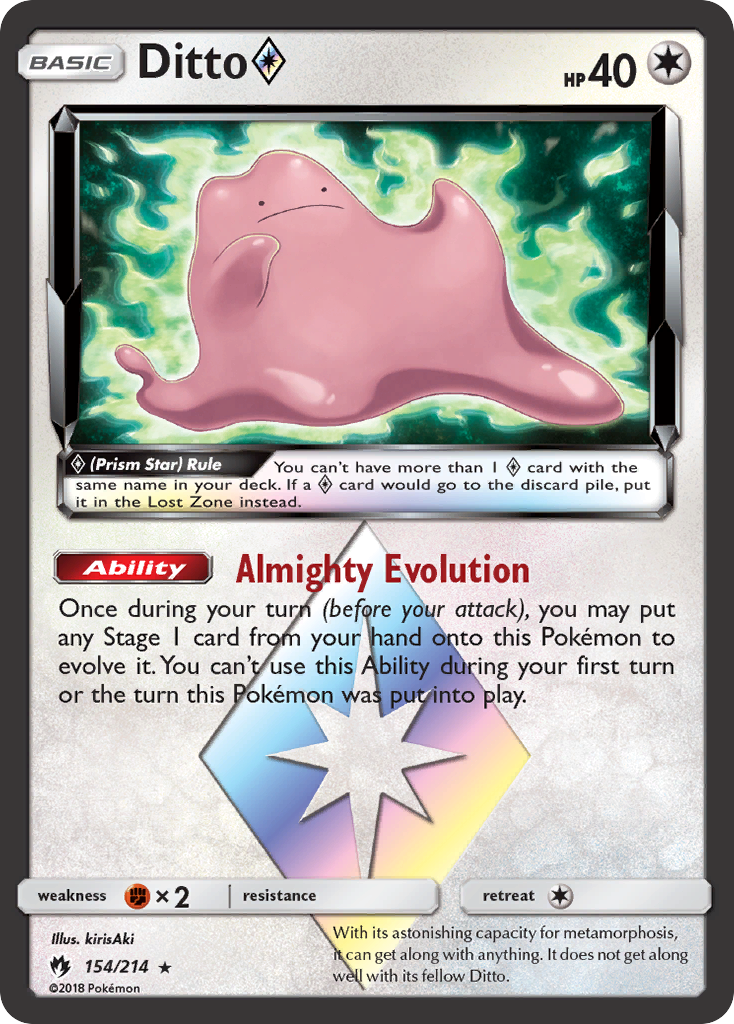
Ditto Prism Star (Lost Thunder) at $12.47. Prism Star cards were a one-time mechanic that will never return to the TCG. You can only run one in your deck, and they go to the Lost Zone instead of the discard pile when knocked out. The Ditto Prism Star lets you evolve it into any Stage 1 Pokemon, which fits the transformation theme perfectly. Limited mechanic, thematic relevance, and a price that’s still in double digits.
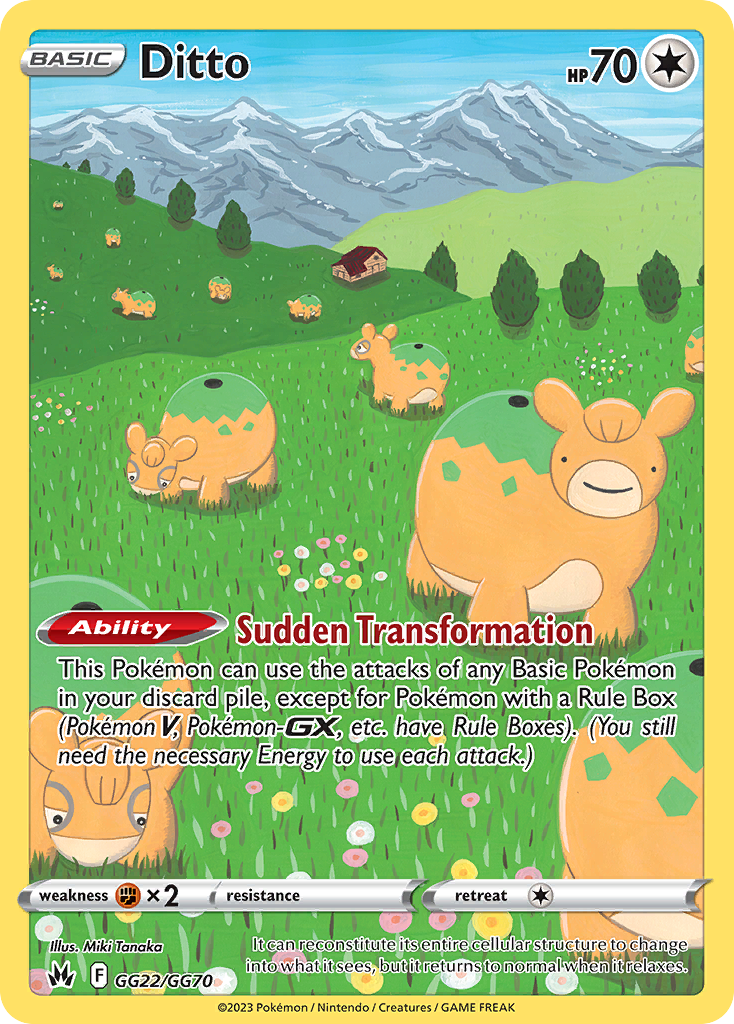
Ditto (Numel disguise) Crown Zenith Galarian Gallery at $12.72. Crown Zenith’s Galarian Gallery cards feature gorgeous full-art illustrations, and the Ditto disguised as Numel is both charming and collectible. Crown Zenith was a popular set, but Galarian Gallery pulls weren’t easy. This one has been creeping up steadily.
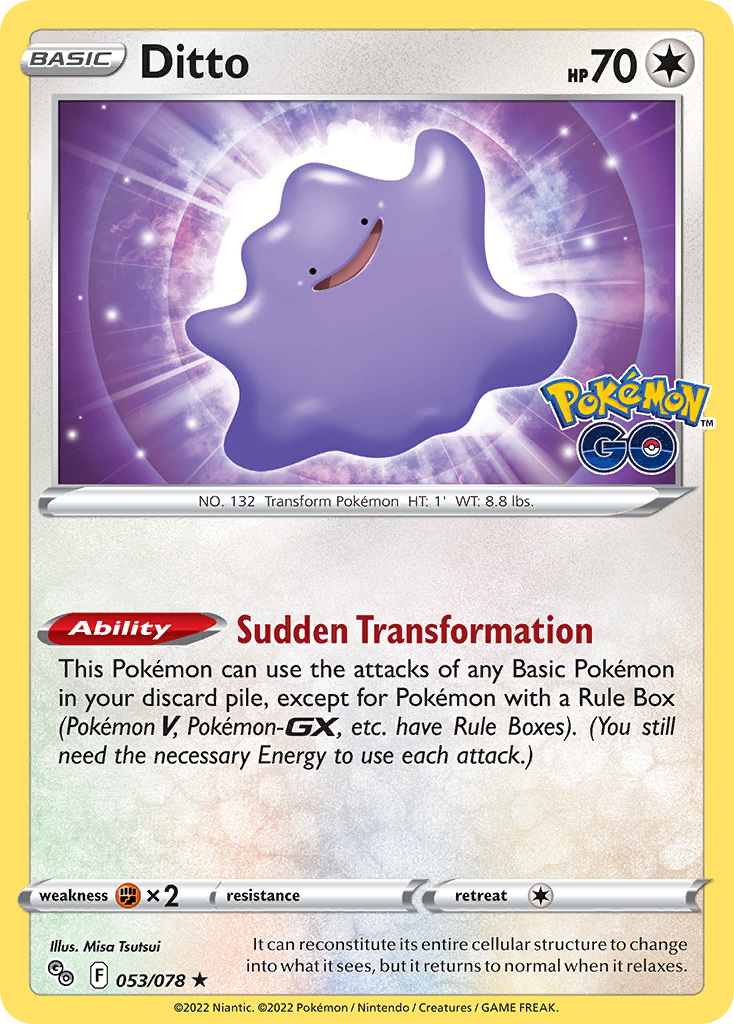
Ditto Peelable Bidoof (Pokemon GO set) at $13.30. This is one of the coolest cards in the modern TCG. It looks like a normal Bidoof card, but you can physically peel off a layer to reveal Ditto hiding underneath. The gimmick factor alone makes it a conversation piece, and Pokopia’s transformation theme gives it renewed relevance. These have been trending up week over week.
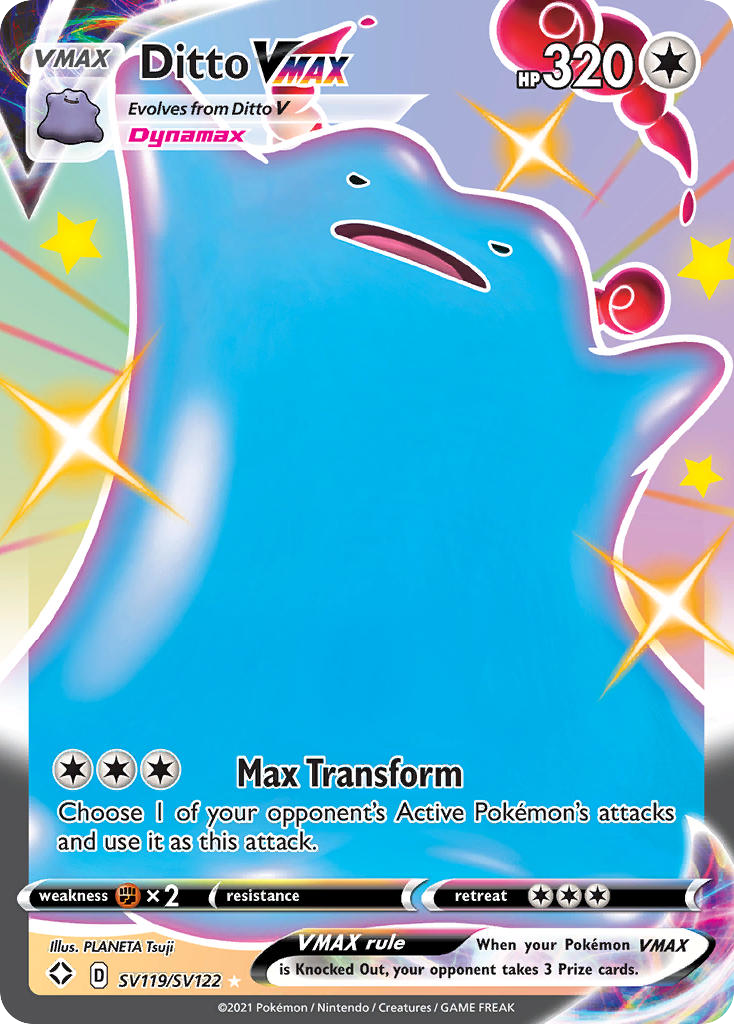
Ditto VMAX Shiny (Shining Fates) at $11.02. Shining Fates was one of the most popular modern sets, and the shiny variants are always desirable. A shiny Ditto VMAX for around eleven dollars feels like a steal when you consider where the rest of the Ditto market is heading.
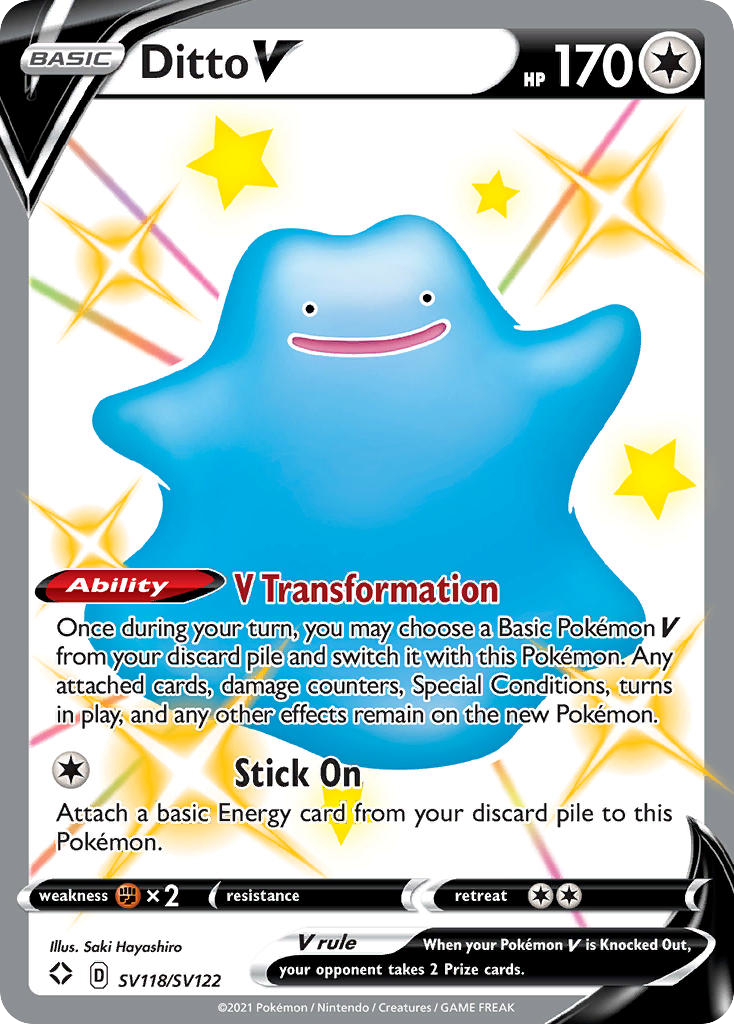
Ditto V Shiny (Shining Fates) at $4.97. Under five dollars for a shiny V card of the Pokemon that just became the protagonist of the highest-rated Pokemon game ever. If this card isn’t at least $10 in six months, something has gone very wrong with the laws of supply and demand.
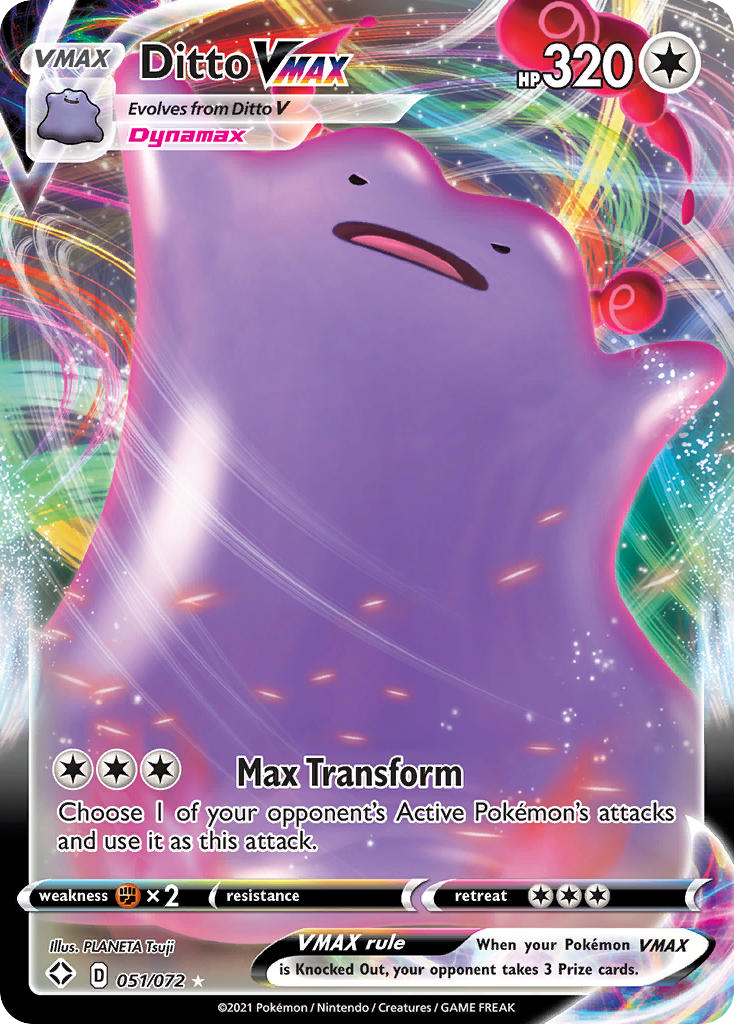
Ditto VMAX (Shining Fates) at $3.39. The non-shiny version of the VMAX. At $3.39, this is basically a lottery ticket. The downside risk is pretty much zero. You’re out the cost of a coffee. The upside if Pokopia sustains its momentum through the holiday season could be real.
These six cards are affordable entry points into the Ditto market. You don’t need to chase the $200+ Delta Species cards to ride the Pokopia Effect. Start here, and if prices keep climbing, you’ll be glad you did.
Is This a Bubble or the New Normal?
This is the question every collector and investor is asking right now, and it deserves an honest answer.
Market analysts who track TCG prices are largely calling this a “natural price surge” rather than a speculative bubble. The distinction matters. A speculative bubble happens when prices rise because people are buying purely to flip. They don’t care about the cards, they just want to ride the wave and sell to the next buyer. A natural price surge happens when genuine fan demand outstrips available supply. The Pokopia Effect looks a lot more like the second one.
Here’s why. Pokopia is still selling out. Switch 2 hardware is still ramping up production, which means there are millions of potential players who haven’t even been able to buy the console yet, let alone the game. Every week, more Switch 2 units ship, more people play Pokopia, more people fall in love with Ditto, and more people start looking at Ditto cards. The demand pipeline isn’t shrinking. It’s growing.
Cross-platform hype is making it even bigger. Pokemon GO ran a Pokopia Celebration Event featuring costumed Ditto spawns, which introduced the Pokopia version of Ditto to the massive mobile player base. A lot of those players had never touched the TCG before, but seeing costumed Ditto in Pokemon GO led them down the rabbit hole of Ditto cards, which led them to their local game shop or TCGPlayer. That kind of cross-pollination between Pokemon’s different platforms creates demand that feeds on itself.
For vintage cards, especially the EX Delta Species transformation cards, the math is simple. These cards are over twenty years old. The supply is fixed and slowly shrinking as cards get damaged, lost, or permanently sealed in graded slabs. Demand just increased by an order of magnitude thanks to the biggest Pokemon game ever made. Prices for these vintage cards are almost certainly not coming back down to pre-Pokopia levels. The floor has been permanently raised.
Modern Ditto cards are a different story. Cards from Shining Fates, Pokemon GO, Crown Zenith, and Lost Thunder exist in much larger quantities. Some of these could settle back down after the initial Pokopia hype wave fades, especially if Game Freak doesn’t keep featuring Ditto in future content. But even modern cards probably won’t return to their pre-Pokopia prices entirely. Ditto’s cultural status has changed for good. It’s no longer the breeding blob. It’s a protagonist, a hero, the Pokemon that carried the highest-rated game in the franchise’s history. That kind of cultural upgrade tends to stick.
The most likely scenario is a two-tier market. Vintage Ditto cards, especially the transformation variants from Delta Species and the rare pulls from Skyridge and Fossil, will hold their gains and likely keep climbing as supply tightens. Modern Ditto cards may see a partial pullback from their current highs but will settle at levels well above where they were before March 5th. Neither tier looks like a bubble in the traditional sense.
The Bottom Line
Pokemon Pokopia didn’t just make a great game. It did something that twenty-seven years of Pokemon media never quite pulled off. It made Ditto a cultural icon. The goofy purple blob that spent decades as a background utility Pokemon is now the star of the most critically acclaimed Pokemon game ever released, and the TCG market has responded hard.
If you’ve been sleeping on Ditto cards, the window is closing on the cheap ones. The Delta Species transformation cards (Squirtle, Charmander, Bulbasaur, Pikachu, and the rest) are already out of reach for most casual collectors. The Skyridge reverse holo is knocking on the door of $300. Even the original Fossil first edition holo has crossed into triple digits.
But budget options still exist. Six solid Ditto cards remain available under $15, all of them with thematic ties to Pokopia and room to run if the hype continues through the rest of 2026. The Shining Fates shiny variants in particular look underpriced relative to the rest of the Ditto market.
Whether you’re collecting because you love the game, investing because you see the writing on the wall, or just picking up a few cards because you played Pokopia and fell in love with Ditto for the first time, there’s a card at every price point waiting for you. Ditto has earned its spot in your binder. Don’t wait until the next wave of Switch 2 shipments to figure that out.
Sponsored
Build Your Collection
Explore more guides, set reviews, and market insights from TCG Collector Hub.
Browse More Guides
Build Your Collection
Discover more guides, investment tips, set reviews, and market analysis from TCG Collector Hub.