Table of Contents
Binders are the beating heart of most Pokemon card collections. They’re where your pulls live, where you show off your favorites, and where the hours of set-chasing finally get to breathe. But not all binders are built the same, and the choices you make when setting one up - the binder type, the sleeves, the organization system - can be the difference between a collection that holds its value and one that quietly degrades over time.
This guide covers everything you need to build a binder collection the right way, from first principles.
Master Set Binders vs. Curated Collection Binders
The first decision to make is what kind of binder you’re building. There are two fundamentally different philosophies, and mixing them up leads to a collection that doesn’t fully serve either goal.
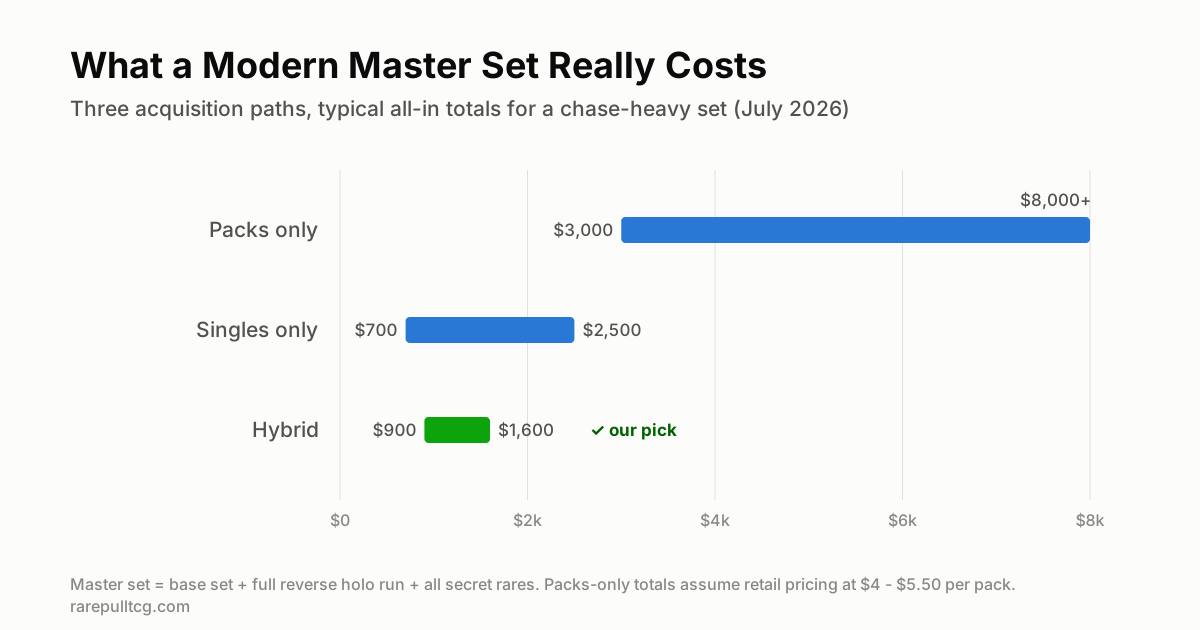
Master set binders are built around completeness. The goal is to own every card in a set, typically sorted by set number, with a slot for each one. A true master set includes all rarity tiers: commons, uncommons, rares, holos, ultra rares, secret rares, and any promos associated with the set. These binders are satisfying to complete, great for documenting a set’s history, and straightforward to organize. The downside is they require a lot of space and a lot of cards you may not personally love.
Curated collection binders are built around personal taste and investment thinking. You pull out the cards that matter to you - your favorite Pokemon, your highest-value pulls, your best alternate arts - and organize them in a way that reflects what you actually care about. These binders are easier to display, more personal, and often more focused on cards that hold or appreciate in value.
Many serious collectors run both: a master set binder for the sets they’re completing, and a curated showcase binder for the hits and favorites they want to protect and display at a higher standard.
The Right Binder Makes a Difference
Once you know what you’re building, the hardware matters. The binder type you choose affects both protection and long-term card condition.
Side-Loading 9-Pocket Pages vs. Top-Loading
This is the biggest decision in binder collecting. The debate has been settled for most serious collectors: side-loading pages win.
Top-loading pages - the kind where you drop a card in from the top - are convenient, but gravity works against you. Cards can slide out over time, especially when the binder is tipped or shifted. Drop a binder the wrong way and you’re picking cards up off the floor.
Side-loading pages require cards to be slid in horizontally, which means they don’t fall out under their own weight. The opening faces the side of the page, and gravity keeps cards seated. For any collection where the cards have real value, side-loading is the only reasonable choice.
Binder Brands Worth Using
VaultX has become the gold standard for many collectors. Their binders use side-loading pages, are built without the D-ring mechanism that causes the most damage (more on that below), and come in a range of sizes. The premium zip binders are particularly well-regarded for protecting cards while traveling or in storage.
Dragon Shield makes a strong competitor. Their Card Codex binders are fully bound with no rings at all - the pages are sewn directly into the spine. That construction eliminates the ring-damage risk entirely. They’re slightly pricier but the build quality is excellent.
Ultra Pro is ubiquitous and affordable. Their standard binders are widely used, but the older ring-bound versions have caused headaches. Look specifically for their newer non-ring binder designs if going with Ultra Pro. Avoid any Ultra Pro product that uses a D-ring binder mechanism for anything beyond commons storage.
The Ring Binder Problem
Standard three-ring binders from office supply stores, or older collector binders with D-ring mechanisms, are a trap. The rings press against the pages and cards on one side of the spine, causing what collectors call “ring dents” - subtle but permanent indentations on the edges of cards that face the rings. This is a condition issue that shows up under grading and kills the value of cards that would otherwise grade well. Unless you’re storing cards you don’t care about, avoid ring binders entirely.
Organization Strategies That Actually Work
There’s no single correct way to organize a binder, but there are approaches that work better depending on your goals.
By set number is the default for master set collectors. It mirrors the official checklist, makes it easy to identify gaps, and creates a visual record of the set in the order it was intended to be experienced. The limitation is that it scatters your favorites across hundreds of slots.
By type is a popular choice for curated binders, especially for collectors who have a favorite Pokemon type. A binder of nothing but Fire types, or every Dragon type alternate art you own, has a coherence that’s satisfying to flip through and easy to show off.
By rarity puts all your full arts, alternate arts, and special illustrations together, separated from the base set. This works well for display-focused binders and makes it easier to quickly assess the value sitting in your collection.
By personal favorites is the most subjective approach and often the most rewarding. If your collection is built around Charizard, Umbreon, Gengar, and a handful of others you’ve always loved, organizing by which cards bring you the most joy creates a binder you’ll actually want to open. That engagement matters - collections you enjoy tend to be maintained better.
For large collections, a hybrid approach works well: master set binders organized by set number for completeness, and a separate showcase binder sorted by personal favorites or rarity.
Protecting Value Inside the Binder
A binder is not inherently safe storage. It’s only as good as the protection you put the cards inside with.
Penny sleeves are non-negotiable. Every card going into a binder should be sleeved first. A bare card sliding into a binder page creates micro-scratches on the surface every time it moves. Those scratches accumulate invisibly until a grader finds them. Penny sleeves are cheap insurance - a few dollars for a pack that protects hundreds of cards.
For higher-value cards, consider double-sleeving: a penny sleeve first, then a higher-quality sleeve like a Dragon Shield or KMC perfect fit over the top before the card goes into the binder page. This adds bulk, so the card fits more snugly in the pocket, and adds a second layer of scratch protection.
Avoid overpacking pages. Binder pages have a rated capacity, usually one card per pocket at standard thickness. Stuffing double-sleeved cards into pages designed for single cards stresses the pockets, warps the pages, and puts pressure on the cards themselves. If your cards are double-sleeved, use pages with slightly larger pockets designed to accommodate the added thickness.
Keep binders upright or flat, not stacked on their spines. Storing a binder horizontally with cards hanging in the pockets puts weight on those cards over time. Store binders vertically on a shelf, spine down, like books.
Display vs. Storage Considerations
Not every binder serves the same function, and understanding the difference helps you make smarter choices.
Display binders are meant to be seen - shown to friends, taken to local card events, or kept on a shelf where you can easily flip through them. For these, prioritize binders that look good and open flat. Presentation matters. Keep your highest-condition cards and most visually striking cards here.
Storage binders are workhorses. They hold your bulk, your commons and uncommons, your duplicates waiting for trades. These can be more utilitarian. Ultra Pro standard pages in a basic binder work fine here. The goal is organization and protection without the premium cost.
The mistake is treating all cards the same. Your PSA 10 candidates and your $50+ alternate arts deserve display binder treatment. Your bulk doesn’t need it.
Tracking What You Have
A binder only works as well as your inventory system. Without tracking, you end up buying duplicates, missing gaps in your sets, and losing track of what your collection is actually worth.
Apps built for Pokemon TCG are the fastest way to get started. TCGplayer and Pokellector both let you catalog cards and track market values. Pokellector is specifically built for set completion tracking, making it ideal for master set binders. TCGplayer’s portfolio tool is better if you’re thinking about investment value.
Spreadsheets give you more control. A simple Google Sheet with columns for set, card name, set number, condition, quantity, and estimated value covers most needs. The upside is full customization - you can build exactly the view that matches your organization system. The downside is manual entry, which gets tedious fast for large collections.
A hybrid approach works well for serious collectors: use an app for quick market value lookups and rough tracking, and maintain a spreadsheet for your high-value cards where precision matters. You don’t need to catalog every common, but every card worth more than $10 should have a record somewhere.
Photograph your valuable cards when you acquire them. A photo with a timestamp is documentation if you ever need to make an insurance claim, dispute a trade, or verify condition before grading.
The Long Game
A binder collection built with the right materials and maintained consistently will hold its condition for years. The value question - whether your cards appreciate or depreciate - depends on the cards themselves. But condition is entirely within your control.
Start with the right binder. Sleeve everything. Track what you have. The rest takes care of itself over time.
Sponsored
Build Your Collection
Explore more guides, set reviews, and market insights from TCG Collector Hub.
Browse More Guides
Build Your Collection
Discover more guides, investment tips, set reviews, and market analysis from TCG Collector Hub.